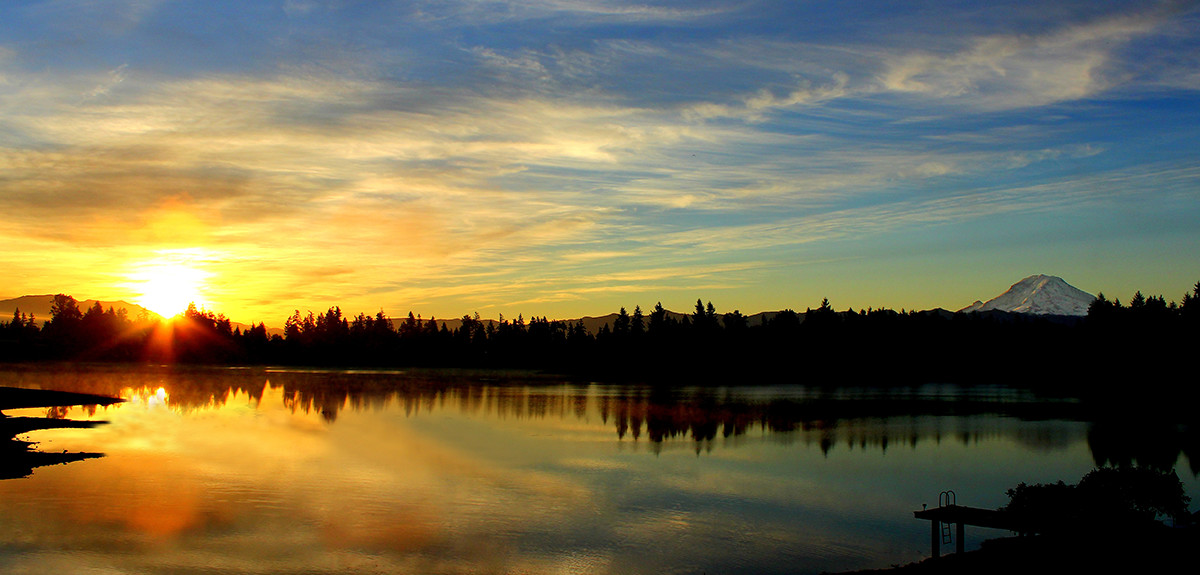
Cascade is all about water – for today and tomorrow – and that means safe and clean water. Cascade's water is of the highest quality, and as new sources come on line, Cascade will treat water to meet or exceed all federal, state, and local quality standards just as our partners Seattle and Tacoma's Public Utilities do today. Extensive monitoring will be conducted prior to designing and constructing a state of the art treatment facility at Lake Tapps. Actual water quality and regulations applicable at the time Cascade builds the plant will determine the exact type and level of treatment required. Ongoing water quality testing and monitoring will be done. Across the country, many surface supply sources similar to Lake Tapps are used for recreation, with treatment technology making these sources extremely safe for drinking water as well.
In order to establish baseline water quality in Lake Tapps, Cascade has cooperated in a number of monitoring efforts since 2004. The Washington Department of Ecology conducted a study of Lake Tapps and the White River in 2004 - 2005 to document water-quality conditions soon after power generation had ceased and when flow through the Lake was reduced. Cascade, Pierce County Public Works and Utilities, the Muckleshoot Indian Tribe and the Puyallup Tribe of Indians also cooperated in collecting water quality data during the 2004–2007 time frame. These studies indicate that Lake Tapps is oligotrophic and that phosphorus is the limiting nutrient for primary production (the Lake tends to function as a net sink for phosphorus). Reduced diversions from the White River and reduced releases from the Lake result in more settling of non-algal particles, including particles with adsorbed phosphorus, resulting in clearer water and lower total phosphorus concentrations.
The most recent and most comprehensive water quality monitoring since Cascade has taken over the Project was conducted from May to December 2010 and was designed by the US Geological Survey (USGS), in cooperation with Cascade and the Muckleshoot Indian Tribe and the Puyallup Tribe of Indians. It was designed to establish a baseline set of data collected under the flow regime contained in the Water Rights Permits for selected reaches of the White River, White River flowline, Lake Tapps and the Tailrace. This report entitled Quality of Water in the White River and Lake Tapps, Pierce County, Washington, May–December 2010 (Scientific Investigations Report 2012-5002) presents and summarizes water-quality data collected by the USGS from May to December 2010 from a total of 13 sites—two on the White River (at the Barrier Dam/Headworks and at R-Street in Auburn), one on the White River flowline, one on the Tailrace returning flow back to the White River, and from nine sites on Lake Tapps. Three sites (at the Headworks, at R Street in Auburn, and the Tailrace) were equipped for continuous 15-minute recording of water quality data. Discrete water samples were collected bi-monthly in July and August at the Headworks and White River flowline sites. The Tailrace site was sampled bi-monthly in July and August and monthly in November and December. Discrete water samples were not collected at the R-Street site; only continuous water-quality data were collected. The nine Lake sites were sampled bi-monthly from July through October and monthly in November and December.
The water-quality data collected for this study consist of concentrations of nutrients, suspended solids, fecal-coliform bacteria, and turbidity in discrete water samples, and 15-minute values of water temperature, specific conductance, dissolved oxygen concentration, pH, and turbidity continuously measured by in-situ water-quality sondes. Water-quality data collected from the Lake sites consist of concentrations of nutrients, suspended solids, fecal-coliform bacteria, chlorophyll a, and turbidity, and vertical profiles of various water-quality and physical properties through the Lake water column. In addition, a one-time sampling of water from three of the Lake sites was analyzed for suites of organic chemicals.
The following is a brief overview summary of the initial results of the 2010 effort:
We've been asked by folks "What can we do to keep our lake clean?" Cascade will be working with the community to determine ongoing actions that might have a detrimental effect on Lake Tapps. We will be observing activities to identify potential target behaviors, that, if changed, would have the greatest positive effect on Lake Tapps water quality. If folks choose, they can download the Behavior Tracking Form and let us know what they are seeing. Please send these forms to contact@cascadewater.org or just let Cascade know you want to help. After Cascade reviews the forms, we will gather additional community information and prepare information on barriers that could discourage or prevent people from changing that behavior. We will then work on key behaviors to change with the community. The result? Hopefully an even better Lake Tapps!
Cascade Launches Lake Tapps Water Quality Effort
We've been asked by folks "What can we do to keep our lake clean?" Cascade will be working with the community to determine ongoing actions that might have a detrimental effect on Lake Tapps. We will be observing activities to identify potential target behaviors, that, if changed, would have the greatest positive effect on Lake Tapps water quality. If folks choose, they can download the Behavior Tracking Form and let us know what they are seeing. Please send these forms to contact@cascadewater.org or just let Cascade know you want to help. After Cascade reviews the forms, we will gather additional community information and prepare information on barriers that could discourage or prevent people from changing that behavior. We will then work on key behaviors to change with the community. The result? Hopefully an even better Lake Tapps!
